|
Previously featured articles have been archived to this section.

5th Generation Warfare?
By Frank Borelli
In translated copies of How to fight alone, and New Methods in Today's Battle, by Muhammed Khalil al-Hakaima. are outlined how to take the current war of jihad to the cities. He urges the study of the human anatomy in order to identify vulnerable areas and to take up martial arts and exercise; utilization of tactics such as stabbings, arson, car bombs and cutting the brake lines on automobiles; how to use narcotics such as cocaine and heroin as weapons and how to use easily available poisons, as well as how to conduct intelligence/counterintelligence against the police and how to infiltrate local police departments. Can this war be making another evolution into potential attacks on individuals with very specialized and focused weapons? Is this a fifth generation (5GW)?
>>Read the article
Back to top

Terrorism Early Warning and Co-Production of Counterterrorism Intelligence
By John P. Sullivan
Traditional security and intelligence approaches have always separated criminal and national security intelligence, as well as domestic and international security concerns. Modern terrorism exploits these seams to operate on a global scale. The Terrorism Early Warning Group (TEW) concept emerged in Los Angeles in 1996 as a way to bridge the gaps in traditional intelligence and security structures. The TEW embraces a networked approach to intelligence fusion and directs its efforts toward intelligence support to regional law enforcement, fire, and health agencies involved in the prevention and response to terrorist acts. This paper discusses the LA TEW model and its practices.
>>Read the article
Back to top

Fourth Generation Warfare: It’s Here and We Need New Intelligence-Gathering Techniques For Dealing With It
By G.I. Wilson, John P. Sullivan, and Hal Kempfer
Lack of situational awareness has long been recognized as a major impediment to executing appropriate courses of action in both combat and law enforcement operations. This shortfall applies not only to fourth generation warfare and response to terrorism, but also to crisis and complex situation incident management (i.e., peace operations, urban operations, counterterrorism, humanitarian emergencies, consequence management and disaster response). We need to anticipate and understand the dynamics of these issues, having not only knowledge dominance but also, more importantly, dominance in understanding the context of action, event, or engagement.
>>Read the article
Back to top

Lessons Learned From Beslan PART TWO:
Preparing For the Inevitable - What American Law Enforcement Must Be Ready For
By John Giduck
In The Summer Edition, Part One: Our Worst Has Got to be Better Than Their Best, presented analysis of the Chechen terrorist attack on Beslan Middle School and provided a lens through which to gain critical perspective for security of American schools. Given the events of Columbine, Beslan and Virginia Tech, many people are re-evaluating the threat of terrorist attacks against soft targets here in the U.S. When you seize a school, you take an entire country hostage. At no time in America have we ever confronted a true terrorist siege, much less one of the proportions of Beslan.
Part Two continues this analysis, focusing on vital lessons for Law Enforcement. Over the day long battle it took to win back the school and save as many hostages as possible, a great many mistakes were made. As well, a great many things were done right. From both of these categories, American law enforcement - particularly American SWAT teams – has much it can learn so that we might be better prepared when the horror comes to pay us a visit.
>>Read the article
Back to top

The Coming Urban Terror:
Systems disruption, networked gangs, and bioweapons
By John Robb
(Originally published in City Journal, Summer 2007)
The same factors that make cities hubs of globalization also make them vulnerable to small-group terror and violence. Over the last few years, small groups’ ability to conduct terrorism has shown radical improvements in productivity—their capacity to inflict economic, physical, and moral damage. These groups, motivated by everything from gang membership to religious extremism, have taken advantage of easy access to our global super-infrastructure, revenues from growing illicit commercial flows, and ubiquitously available new technologies to cross the threshold necessary to become terrible threats. September 11, 2001, marked their arrival at that threshold.
>>Read the article
Back to top

Fourth Generation Warfare & OODA Loop Implications of the Iraqi Insurgency
By G.I. Wilson, Greg Wilcox, and Chet Richards
Our dilemma in Iraq is reestablishing a sovereign Iraq where any action on our part to do so can easily contribute to de-legitimizing it while trying to sustain combat and security operations. The situation is aggravated by the presence of small numbers of terrorists (foreign interlopers) enmeshed in a culture of shifting alliances against a backdrop of religious and tribal hierarchies. Iraq has become a field laboratory for a class of insurgent-terrorists well schooled in fourth generation warfare and supported by angered Iraqis.
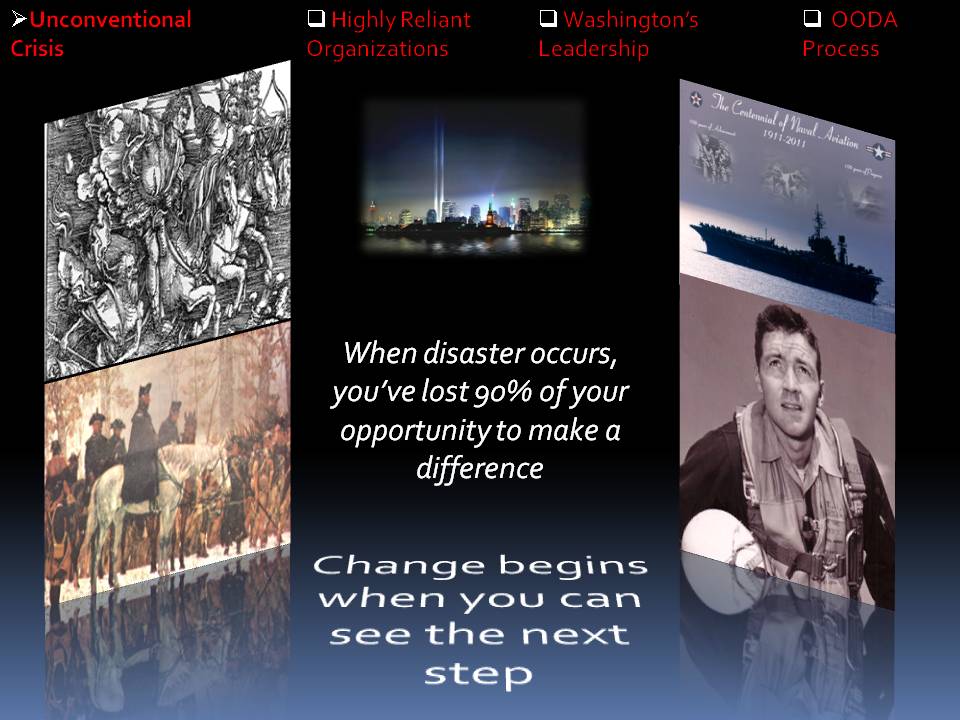
Iraq as Fourth Generation Warfare as viewed in context of Observe-Orient-Decide-Act
>>View the Presentation
Power Point Viewer
PDF format

Fourth Generation Warfare
Excerpt From: Dear Mr. & Ms. 1RP: Welcome to the 21st Century
By Dr. Chet Richards
War as it evolves, in response to changes in the world’s social, political, and economic condition, becomes more and more a non-state organization operation, but still with intent to coerce another group of people into doing something they would rather not do. The term, first introduced in a 1989 paper in the Marine Corps Gazette, is Fourth Generation Warfare (4GW). Because they can’t field sizable amounts of conventional military hardware, 4GW forces will never try to achieve victory by defeating the military forces of a state in stand-up battles. Instead, they will try to convince their state opponent that it is simply not worth it to continue the fight. An unpleasant fact of 4GW is that like insurgency from whence it sprang, 4GW will be a protracted struggle. But the most unpleasant fact of 4GW is that in it, we have finally reached the level of total war - in the eyes of the 4GW attacker, there are no civilians and no non-combatants. A concern for public relations offers the only reason for limiting the scope or violence of the attacks.
>>Read the article
For a graphical depiction of how the "generations" evolve, please download: The Evolution of Conflict (196KB PowerPoint - version 3, January 2007) (Once the PPT opens use “right click” and advance)

Adaptive Leaders Course (ALC)
Teaching Old Dogs New Tricks
By Major Donald E. Vandergriff, U.S. Army (Ret)
In the pre website, very earliest, Project White Horse 084640 writing, it was highlighted that a study for the Under Secretary Of Defense for Personnel and Readiness, by the Institute for Defense Analyses (IDA) identified “adaptability,” as THE key skill required in the emerging century based on the high level of asymmetry and uncertainty anticipated in world events and potential conflicts. How to acquire that skill was and is a key issue. “Teaching an Old Dog New Tricks” and then “how to Teach” lays out how Army leaders – officers, NCOs and civilians – “enable adaptability” in students through an educational model called the Adaptive Leaders Course. The key to an ALC is on developing Teachers of Adaptability because ALC can only be effective with them. “Turn-key” lesson plans and fixed lesson plans memorized by instructors do not substitute for Teachers of Adaptability. Teachers of Adaptability continually update and prepare extensively so that they facilitate the development of adaptive leaders. This effort is not going to be easy, but the reward will be great for the student, instructor, the Army, and the nation. Major Vandergriff’s work, reflected here and in the highlighted book Raising the Bar, offers a significant effort and resource for other agencies on creating adaptability capability for decision makers.
>>Read the article
Back to top

“All Hazards Approach” To Network-Centric Disaster Management: The Role Of Information And Knowledge Management, And Boyd’s OODA Loop In Disaster Leadership
By Dag KJE von Lubitz, James E. Beakley, and Frédéric Patricelli,
Selected for publication by Disasters: The Journal of Disaster Studies, Policy and Management,
Blackwell Publishing, U.K.
The ever increasing complexity of disasters demands utilization of knowledge that exists outside domains traditionally used in disaster management. To be operationally useful, such knowledge must be extracted, combined with the information generated by the disaster itself, and transformed into actionable knowledge. The process is hampered by existing, business-oriented approaches to knowledge management, technical issues in access to relevant, multi-domain information/knowledge, and by the executive decision processes based predominantly on historical knowledge. Consequently, as shown by many recent incidents, the management of large scale (mega) disasters is often inefficient and exceedingly costly. The paper demonstrates that integration of modified Information and Knowledge Management with the concepts of network-centric warfare (NCW) operations and network-enabled capabilities (NEC), and with Boyd’s OODA Loop-based decision-making in unpredictable and dynamically changing environments may address some of these problems.
>>Read the article
Back to top

Expecting the Unexpected: The Need for a Networked Terrorism and Disaster Response Strategy
By W. David Stephenson and Eric Bonabeau
Reprinted by permission of the authors
First published in Homeland Security Affairs, February 2007
Since Hurricane Katrina, attention has focused on improving management of response to natural disasters and terrorist attacks. Given that we will not necessarily succeed in deterring terrorist attacks, how do we respond in the event of such attacks or to natural disasters? This essay argues that terrorist attacks or natural disasters are likely to be so unpredictable that they frequently require improvised responses (as conventional hierarchical structures are ill-suited to such situations) and outlines a flexible and highly adaptive networked structure. The most effective of these responses are those that exhibit “swarm intelligence” – the ability of a community, even an ad hoc one, to demonstrate a higher level of collective behavior than could be predicted from the capabilities of individual members. As examples of swarm intelligence, Stephenson and Bonabeau point to the actions of passengers aboard United Flight 93.
>>Read the article
Back to top

Changing Homeland Security: Ten Essential Homeland Security Books
By Christopher Bellavita
Director, Academic Programs, Center for Homeland Defense and Security
Naval Postgraduate School
Reprinted by permission of the author
First published in Homeland Security Affairs, February 2007
Much has been written about homeland security. A lot more is in the publishing pipeline. Christopher Bellavita offers works he believes outline a broad historical narrative about homeland security: we were attacked, we worked to develop a strategy to prevent future attacks, and then we took the first steps to institutionalizing the study and development of homeland security and defense. Analyzing works as diverse as the 9/11 Report, Imperial Hubris, and the Constitution of the United States, Bellavita argues that the process we are going through as a country (as demonstrated in these ten works and including recent criticism of current policies) is natural and necessary. He concludes with the Articles of Confederation (1777) to remind us that, like this country’s founders, “we should not exclude the possibility of rethinking, as a nation, how we approach homeland security…Beyond personal interest, I believe they form a foundation for a growing understanding of the parameters of what it means to study homeland security as a professional discipline.”
>>Read the article
Back to top

Our Worst Has Got To Be Better Than Their Best
By John Giduck
Senior Consultant & Instructor Archangel Group
Author of Terror at Beslan: A Russian Tragedy With Lessons for America's Schools
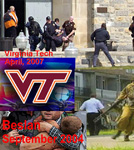
The events at Virginia Tech are only weeks old, all too fresh in our minds. The terrorist atrocity at the Beslan Middle School No. 1 in southern Russia from 1-3 September 2004 is now almost three years old. From a law enforcement, government and military perspective, the study of this atrocity is relevant and extremely important because it reflected a terrorist-mass hostage siege demonstrating the most current evolution of tactics of al Qaeda and its related groups, cleaving closely to basic al Qaeda doctrine for such attacks. But perhaps the most significant point is that it represents the worst terrorist attack that we might ever face here in America. John Giduck was there. As detailed analysis of the killings at Blacksburg begin, as a high level commission begins, with the tools to not just look, but to “see” and understand - background in special operations and long time connectivity with the responders – Giduck’s analysis of Beslan provides a lens through which to gain critical perspective.
>>Read the article
Back to top

Preliminary Findings on VA Tech Shootings, by John Giduck, Senior Consultant & Instructor- Archangel Group; Deputy Chris Hays, Orange County (CA) Sheriff’s Office; Capt. Joe Bail, Chester (PA) Police Department
Since the shootings at Virginia Tech (VT) on Monday, 16 April 07, news media and experts alike have been expressing opinions which are critical of the response by both VT and Blacksburg police. The authors, with extensive experience in Special Operations and Special Weapons and Tactics (SWAT) operations, traveled to VT to assess the overall event and particularly, the tactical response. In order to attempt to reduce the speed with which the negative conclusions were/are being drawn, and the degree to which they are already taking on the mantel of absolute truth, they determined to present an initial report in hope that some preliminary information will begin to help correct the record on this matter, or at least slow down the dissemination of erroneous information and baseless conclusions.
“Our efforts in traveling to VT were to obtain as much accurate information as possible on the tactical situation confronted and the operation that was ultimately launched, and then to assess and evaluate the tactical response under the totality of circumstances with which they were confronted at the time. Our ultimate goal was to determine as many lessons to be learned as possible, so that all law enforcement might be better prepared for attacks that are yet to come; a reality we think everyone recognizes. We are now in the process of preparing a detailed written report on the tactical aspect of the VT shootings.”
>>Read the article
Back to top

DaVinci's Horse:Perspectives on Decision Making in Crisis (Part 3), by Ed Beakley
We have to accept that the world has changed and as Sun Tzu wrote in the 5th Century B.C., we must know the enemy and ourselves. We have done little of either. We expect government to take care of business by strengthening what is fragile or not secure and by responding when called. But mostly we hope against hope that calamity isn’t around the corner. As a result, America is failing one of the most important tests of national capability and resolve we have ever faced.
>>Read the article
Back to top

Detours Off the Path to 9/11, by Cyrs Nowrasteh
Re-published by permission of the author
Original publication December 2006
Written By The Magazine of the Writers Guild of America West
Cyrus Nowrasteh is the author and producer of the ABC/ Walt Disney docudrama "The Path to 9/11," a two-part miniseries loosely based on the 9/11 Commission Final Report issued July 22, 2004, and the 2003 book The Cell: Inside the 9/11 Plot and Why the FBI and CIA Failed to Stop It by journalists John Miller, Michael Stone, and Chris Mitchell. With few exceptions, most of the TV and print media launched a campaign to discredit the six hour mini-series. Six U.S. senators sent a letter to Disney/ABC threatening revocation of their station licenses. Why?
And yet, Michael Scheuer, former chief of the Osama bin Laden unit at the CIA’s counter-terrorist center, e-mailed ABC News in the midst of the controversy to insist that “the core of the movie is irrefutably true.” Steven Emerson, one of the foremost terrorism experts in the world, a man who has testified before and briefed Congress dozens of times on terrorism, said that “The Path to 9/11 is 100 percent accurate.”
Nowrasteh: “Sadly the hysteria distracted from the message…From the first day to the last, it was a simple one: to enact in historically accurate fashion that 9/11 was merely one more step in an escalating pattern of Islamic fundamentalist terrorism against the U.S; … to place 9/11 in context; … to connect the proverbial dots of the past in hope that we can connect them better in the future.
>>Go to the article
Back to top

Strategies of Decision Making, by Dr. Gary Klein
Re- published with permission of the author. Original publication: Military Review, 1989
RPD concepts continuation by Dr. Klein:
Sources of Power; How People Make Decisions, 1998 (Review on this site)
The Power of Intuition, 2003
This article posits that military decision makers (PWH note: Submit that issues apply equally to military and public safety first responder support processes) have come to rely too heavily on analytical decision-making processes, contributing to a reduction in the effectiveness of training and decision support systems. The author examines the strengths and weaknesses of competing decision-making processes and offers a “recognition model” for use in most combat or field situations….
Experienced decision makers do an excellent job of coping with time pressure and dynamic conditions. Rather than trying to change the way they think, we should be finding ways to help them. We should be developing techniques for broadening their experience base through training, so they can gain situation assessment more quickly and accurately.
>>Go to the article
Back to top

DaVinci's Horse, by Ed Beakley
Saper vedere – sapio audacter – sapere aude
September 10, 1999, five hundred years to the day from the date that invading French armies destroyed Leonardo da Vinci’s full size clay model, Il Cavallo, a 24 foot bronze horse, created directly from da Vinci’s detailed notebooks was unveiled in Milan Italy.
In the coming years, no learning paradigm shift will be more needed and forcefully felt than the enrichment of thought through cross-pollination. Da Vinci’s body of work has provided a highly workable model for how this shift might be accomplished. His was a new view on cognition- the artist as transmitter of the true and accurate data of experience acquired by visual observation. He developed a unique theory of knowledge in which art and science form a synthesis – with multiple perspectives as key – saper vedere- “to see is to know.”
While da Vinci’s Horse stands as a symbol of the Renaissance and his unique perspective, creativity and gifts to the world, when historians look back on America and the problems unmasked by the attacks on September 11, 2001, what will be noted as our symbol of creative response in the 21st Century? Indeed, will there be one?
>>Go to the article
Back to top

Introduction to DESTRUCTION AND CREATION, by John R. Boyd
The first edition of the Project White Horse website featured Dr. Chet Richards’ adaptation and amplification of John Boyd’s Observe-Orient-Decide-Act loop. Presentation, analysis, and discussion (and eventually derivative concepts synthesis) stemming from Boyd’s over arching work, “A Discourse on Winning and Losing,” provides a significant departure point for this website, given its stated focus on time critical decision making in crisis.
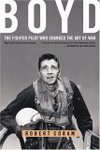
John Boyd was the rarest of people – fighter pilot with all the traits thereunto, engineer whose Energy- Maneuverability theory revolutionized fighter aircraft design, researcher, historian, intellectual, and military strategist whose concepts place him in the rarified company of Sun Tzu, Miyamoto Musashi, and Carl von Clausewitz. To move through “A Discourse” and follow the path he took to his final offering “The Essence of Winning and Losing” is an education in itself.
Because I believe his work so crucial to the study of time critical decision making in crisis, this edition features as complimentary efforts, both very different biographical approaches by Grant Hammond and Robert Coram, and to emphasize that his intellectual legacy encompassed much more than warfighting, is universal, timeless, and applicable to any form of conflict, Chet Richards’ application of Boyd’s concepts to business is also featured.
Boyd’s Air Force career and experience as a fighter pilot underpins all, but his beginning as a military and competitive strategist, the basis for “A Discourse on Winning and Losing” and his ultimate legacy in history launches from the 1976 publication of the paper “Destruction and Creation.” This abstract treatise describes how an interplay of analysis and synthesis destroys and creates our mental images of the external world - disorder turns into order which turns into disorder in a never ending cycle. To survive in a complex world on our own terms - to improve our capacity for independent action –- we must understand how to “comprehend, shape, adapt to, and in turn be shaped by an unfolding, evolving reality that is uncertain, ever changing, unpredictable.”
No better beginning for Project White Horse 084640, as a forum on decision-making than John Boyd’s “Destruction and Creation” with hyper links to commentary by one of Boyd’s closest friends, Chuck Spinney.
>>Go to the article
Back to top

Boyd's OODA Loop, by Chet Richards
(This short PowerPoint presentation on the Observe-Orient Decide Act (OODA) Loop developed by the late Colonel John Boyd, and adapted and explained by Dr. Chet Richards and used by permission, has been selected to be the first Guest Article for this website. Understanding the Boyd Loop in the way it was intended, in my opinion, is absolutely crucial for decision makers of this century. It clearly provides the baseline for all future White Horse effort and discussion.
Chet Richards was a close associate of Colonel. Boyd from the mid-1970s until Boyd’s death in 1997. Boyd had asked him to review the mathematical portions of his first civilian paper, “Destruction and Creation,” and this led to a collaboration that eventually included applications to business. Chet owns and operates two sites devoted to John Boyd’s strategic legacy, Defense and the National Interest and Belisarius.com, both listed in “Links.” Chet is a noted author (work included on this site) and continues to consult and lecture on Boyd’s strategy and its application to business. He is the only person who has presented Boyd’s 8-hour synthesis of strategy, Patterns of Conflict, since Boyd’s death.) (JEB)
It’s worth pointing out that the OODA “loop” is a way of thinking about organizational behavior. Boyd once called it an “operational scheme for organizational success.” It provides a common framework to help individuals and organizations focus on ways to improve their competitiveness. When leaders talk about the need for more implicit communications or the need to improve re-orientation times, people throughout the organization will know what they are talking about and why. Essentially, the purpose of the OODA loop model is to enable organizations to change their environments before opponents can comprehend.
>>Click here to view a short PowerPoint presentation with notes<<
Back to top

|